
The Real Cost of Your Electric Bill
- and how to take control
Problem Statement
The global climate is warming at an alarming rate, and despite ongoing efforts, global CO₂ emissions keep hitting all-time records. This is mainly due to population growth and economic development in India, China, and much of Asia (2025, Our World in Data). At the 2025 Paris Agreement, the EU pledged a bold target: cut emissions by at least 55% by 2030 compared to 1990 levels, aiming for climate neutrality by 2050. Thanks to technological advances, electrification of transport, and improved insulation and building techniques, Europe is well on track to meet this ambitious goal.
Still, our per capita carbon footprint remains one of the highest worldwide. Developed countries have a big responsibility to lead the way. Those who take on this challenge can benefit directly and indirectly. Indirectly, by capitalizing novel green technologies as goods and services to grow a sustainable economy. Directly, by cutting carbon emissions, which boost productivity and lower costs — a win all around.
Companies can reduce greenhouse gas emissions in different ways, categorized as scope 1, 2, and 3:
Scope 1: Direct emissions from owned or controlled sources, like fuel burned in industrial processes or heating systems.
Scope 2: Indirect emissions from purchased electricity.
Scope 3: Indirect emissions across the entire value chain, including upstream activities like supplier operations and raw material extraction, as well as downstream activities such as product use and recycling or disposal of the end product.
Households can do their part too — by cutting back on flights, eating less meat, improving home insulation, and switching to electric heating, cooling, and transport. Since not everyone is willing to give up their favorite weekly steak or that annual family trip to Curaçao, it’s often more appealing to invest in your home instead. Investing in solar panels, heat pumps, or an electric vehicle lets you shrink your carbon footprint while saving on your electricity bill.

Challenges and Opportunities in Renewables
To save both our climate and economy, electrifying industry and households is essential. Heat pumps, for instance, deliver 3-5 units of heat per unit of electricity, far above the ~90% efficiency of gas boilers. Large gas power plants convert about 55–65% of gas energy into electricity, making heat pumps powered by such electricity a superior technology despite initial conversion losses. Transitioning to fully renewable electricity combined with heat pumps offers the clearest path to net-zero emissions.
Looking ahead, McKinsey’s Global Energy Perspective 2025 predicts renewable energy will grow at an annual rate of 8% (CAGR) over the next 25 years. In other words a staggering 685% increase by 2050. This tremendous growth brings new challenges alongside opportunities. For instance, as renewables and electricity demand rise, periods with limited wind and sun can make electricity scarce and volatile, leading to price spikes and a more complex balancing act for the grid. But this doesn’t have to be a problem — we can turn these challenges into advantages. Read my other post about how this challenge is turned into an opportunity at a local butcher.
Many companies have long focused on reducing baseline energy consumption, but few have truly adopted innovative strategies that leverage flexible energy assets and engage in various energy markets:
Day-ahead market: This is where electricity is bought and sold one day before it is actually used. People guess how much power will be needed and make their plans. This helps them get better prices and keeps the grid stable by balancing supply and demand in advance.
Intraday market: This market allows trading electricity within the same day it’s used. It lets people adjust their plans last minute if there are surprises or errors in the initial predictions. This provides more flexibility to respond to changes in real time.
Imbalance market: Sometimes, the actual amount of electricity used or produced is different from the amounts planned in the day-ahead or intraday markets. The imbalance market fixes these differences by encouraging accurate predictions and rewarding or charging based on how well participants kept their promises.
Reserve markets (aFRR, mFRR): These are backup power markets. Participants agree to keep some extra capacity ready to quickly supply power if there’s a sudden shortage or spike in demand. This standby power helps keep the electricity grid reliable and they get paid for being available and for the power they provide.
Each market offers unique opportunities to optimize energy use, reduce costs, and help maintain grid reliability, especially crucial as renewables increase and demand fluctuates. Central to all these strategies is the power of data analytics and AI. By identifying key energy drivers, improving forecasts of production and consumption, and increasing cost transparency, these technologies enable smarter, more efficient energy management.
While a detailed exploration of industrial applications goes beyond this post, I want to share a personal use case that highlights these principles in action.
Personal Experience
Recently, we bought a residential Huawei battery with a smart Energy Management System (EMMA). Finding a setup that met all our expectations yet remained affordable was a challenge in itself. The system’s AI learns and predicts consumption and production patterns to optimally charge and discharge the battery based on your electricity price. This requires a dynamic contract linked to the EPEX (day-ahead) energy market. Properly configuring these parameters is crucial to let the algorithm make the right decisions.
Understanding your electricity bill is another puzzle. In the figure below, I made a simulation based on my current dynamic contract with Engie (November 2025 - Engie Dynamic). In Flanders, only about 42% of the bill pays for actual electricity consumption. The rest covers taxes and infrastructure, managed by multiple players like Elia, responsible for the high-voltage grid, and Fluvius, overseeing the regional (low and mid-voltage) distribution networks. Distribution and transmission costs account for roughly 30%. Where capacity tariffs, basically penalties based on your monthly peak usage, make up the biggest share. This can hit households charging electric cars even harder, with capacity fees escalating to over €370/year for a 7 kW charger.
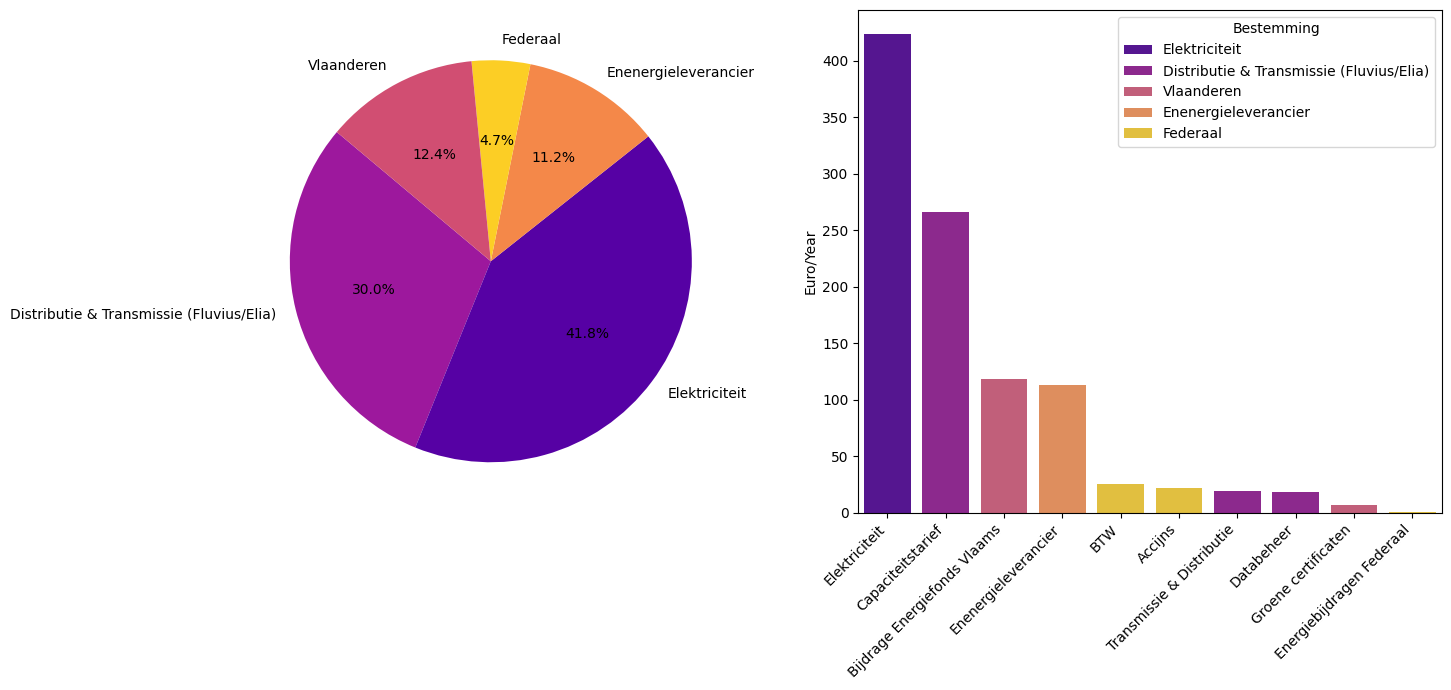
Figure: Energy cost simulation based on Engie Dynamic contract with total yearly electrictiy consumption of 4000 kWh/y, average yearly peak consumption of 5 kW and average estimated price of eSpot November based on the VREG 84,77 €/MWh.
The problem is that this tariff currently offers no incentive to shift consumption to times when electricity prices are negative or when the grid faces large imbalances. In other words, if you have a smart battery that could charge rapidly during these periods to alleviate grid stress, the tariff structure does not reward you for doing so. This misses an important opportunity to use consumer flexibility as a lever for grid optimization.
Added to this are fixed fees for metering and data handling, and no transparency how cost are allocated between Elia and Fluvius that add to the confusion.
On top of this, the Flemish government plans to invest more than €7 billion in Fluvius over the next decade to support the energy transition. Fluvius is organized into eight intermunicipal companies (intercommunales), each with its own board of directors, altogether 457 directorships and 20 regional management committees (2025 July, De Tijd Opniestuk: Ook 1,56 miljard euro Vlaams geld zal energiefactuur niet doen dalen). While this complex structure ensures local governance, it also adds overhead that complicates efforts to simplify and reduce costs.
Furthermore, we pay a fair share to the electricity producers. The rest consists mainly of taxes for both the Flemish and Belgian Federal Government. What’s also remarkable is the small fee households must pay for so-called green certificates, which subsidize combined heat and power installations and large renewable electricity producers. Interestingly, households with PV-solar panels must also pay these fees, even though they are excluded from these financial incentives.
To wrap up, there is also the Energy Fund Contribution applied in Flanders if you have more than one energy contract, an inevitable situation when building or renovating a house. In this case, you end up punished as collateral damage in a well-intended attempt to tax the wealthy.
conclusive thoughts
You would expect policymakers to prioritize affordable clean energy, abate Green House Gas emissions, foster innovation, and increase competitiveness across industries. Taxes should be smart instruments to stimulate — not hamper — innovative strategies that make the energy transition possible. Instead, today it’s a challenge just to calculate and update price coefficients to optimize power consumption with premium Chinese solar panels and batteries.
Despite these hurdles, the energy landscape is moving fast. As a data and AI specialist, I’m here to listen to your challenges and help you navigate smarter, more sustainable energy solutions — making your energy use efficient, cost-effective, and aligned with the future.
Start monitoring your energy consumption and get a clear view on your revenue streams is a first step towards opartional excellence.
